
Jackson Transitional Release Routes
The county describes a 14-bed transition center operated through Jackson County Correctional Institution. It belongs to the correctional-institution path, not the Sheriff’s pretrial jail path. A resident can be close to community return yet remain in an authorized placement. Movement back to Jackson County CI, to another GDC facility, to parole or probation supervision, or into the community can each look like a departure but carry a different legal status.
Confirm the outcome through the GDC offender record, the parole board’s tools when parole applies, DCS when supervision follows, and facility or GDC records for details. The Jackson County release search compares those channels with county-jail records.
Confirm Jackson Transitional Release
Use the official GDC offender query. Search by name or GDC identifier and review both active and inactive records when the status is uncertain. The Released In The Past 15 Days filter can help with a recent state release, but the institution field may show placement history rather than the resident’s present location.
- Search the GDC name and ID fields.
- Compare active, inactive, and both-scope results.
- Read status and institution fields together.
- Check the TPM tool only for a tentative parole month.
- Use the parolee database after release to parole.
- Contact DCS or request records when supervision or discharge remains unclear.
A TPM is not a final release order. DCS supervision can follow release, while transfer to another correctional placement means custody continues. The evidence must identify which event occurred.
Jackson Transitional Release Records
Ask for the record that identifies the end of the transition placement and the next legal status. Useful identifiers are the full name, GDC ID or case number, and approximate placement period. Request the release, discharge, transfer, parole, or supervision event rather than a general institutional file. That wording helps distinguish community return from movement back into another correctional placement.
GDC Records and Verification
Georgia Department of Corrections
300 Patrol Road
Forsyth, GA 31029
Public information: 404-656-4661
Inmate Records: PO Box 1529, Forsyth, GA 31029
The GDC open-records page directs requests to the state portal. GDC states that an initial response is provided within three business days, non-medical copies cost ten cents each, and search or redaction work may be billed. Facility-specific questions can also be routed through the correctional institution.
Jackson Transitional Center Contact
The transition center is tied to Jackson County Correctional Institution at 265 I.W. Davis Road in Jefferson. The county publishes a separate transition-center contact number. Use it for local program or placement questions, while GDC handles statewide offender status and formal state records.
Transitional Center
Jackson County Correctional Institution Transitional Center
265 I.W. Davis Road
Jefferson, GA 30549
County contact: 706-367-1199
Give the full name and GDC identifier if known. Ask whether the person remains in a correctional placement, transferred, or completed the placement into parole, probation, or another status. The Sheriff’s jail line is not the release-record route for this center.
Jackson Transitional Supervision Path
A transition-center placement is not a county-jail bond situation. The person is on the correctional-institution track, and the next step may involve parole, felony probation, another GDC placement, or completion of the state sentence. The Board controls parole decisions. DCS supervises felony probation and parole after community release.
Use the Board’s parolee database after a parole release and the DCS field-office locator for supervision contacts. A Tentative Parole Month is only a planned review point, not confirmation that a resident left the center. GDC inactive status, a parolee record, DCS verification, or an official response provides stronger evidence.
Jackson Transitional Custody Transfers
A resident may leave this small unit for Jackson County CI, another GDC institution, community supervision, or another authorized destination. Only some of those events are releases to the community. Read the GDC status and facility fields together, and request the destination when the online entry shows movement without explaining it.
Jackson County’s immigration-report page applies to Sheriff custody and is not a transition-center release list. Its custody-transfer lesson still applies: departure from one place can mean a handoff rather than freedom. Federal and ICE locators should be used only when an official record identifies those systems. Otherwise, GDC and the correctional institution remain the correct sources.
Jackson Transitional Center Background
The center is tied to Jackson County Correctional Institution at 265 I.W. Davis Road in Jefferson. The county reports a capacity of 14 beds. That small, reentry-oriented setting is distinct from the Sheriff’s jail and from the main medium-security correctional-institution population. Capacity is a facility fact, not a daily occupancy or release count.
The official Jackson County Transitional Center page is the source for the program and capacity. The matched screenshot below shows that local facility page.
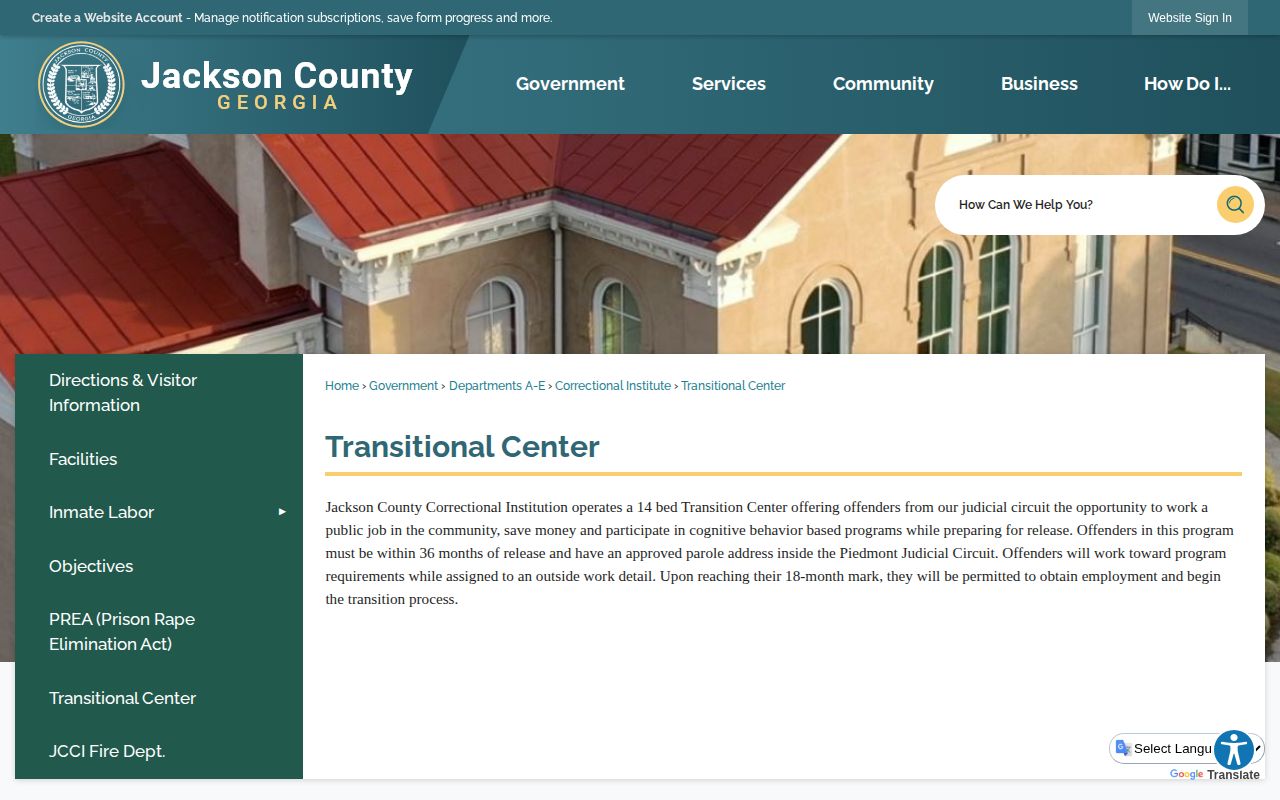
The transition program explains why a person can be near community return without yet being fully discharged. Use GDC status and the supervising agency for the actual release determination.
After a Jackson Transitional Release
Community return may be followed by parole or felony probation. DCS, rather than the Sheriff or transition-center staff, handles that supervision. The Board’s parolee database can confirm a parole record, while DCS supplies field-office contacts. If the person maxed out without supervision, the GDC discharge record is the more relevant source.
What if no online result appears? Search active and inactive GDC scopes using an identifier, then contact the facility or request the state record. Absence alone does not show that the placement ended or that the person entered the community.
Jackson Transitional Status Fields
The GDC search supports name, alias, age range, race, gender, physical descriptors, sentence status, institution, GDC ID, and case number. When a transition-center resident is expected to leave, select Both Active and Inactive rather than assuming the change has already occurred. Only Inactive Offenders is useful after a confirmed discharge. Released In The Past 15 Days can narrow a recent event, but the result still needs to be read for its actual status.
Institution history does not prove present residence. A record can retain a Jackson County connection after movement elsewhere, and a facility filter can omit someone whose placement changed. Identifiers are more reliable than repeatedly filtering by the transition center. When the entry is ambiguous, request the movement, release, or discharge record from GDC.
Jackson Transitional Release Dates
Maximum Release Date and Tentative Parole Month answer different questions. Max out is tied to complete service of the judicial sentence, excluding a parole decision. A TPM is the month in which the parole board expects to complete final review and possibly set a release date. It can change before the person leaves. Neither term means that residence at the transition center has ended today.
Georgia’s Performance Incentive Credit program may allow eligible state offenders to reduce length of stay through progress in programs, work assignments, and good behavior. GDC says up to twelve PIC points may translate into one to twelve months off a TPM or Maximum Release Date, subject to eligibility limits. The current official record remains controlling because credits and Board review can change a prior estimate.
Jackson Transitional DCS Verification
DCS supervises people granted parole and people serving felony probation or split sentences. Its field-office locator is the proper route for local supervision contacts after community return. The statewide DCS phone is 678-783-4337, and published office hours are Monday through Friday, 8 a.m. to 5 p.m. Eastern. Facility staff can explain the placement, but they are not the statewide community-supervision office.
A parolee database match, DCS contact route, and inactive GDC status can reinforce one another. If they conflict, request the official status record rather than choosing the most convenient result. Data updates can occur at different times, especially around a movement from the center into community supervision.